


James Simpson Era
(1881-1903)
Builder of SDSD’s Foundation and Growth
James Simpson, a deaf educator, served as the third superintendent of the South Dakota School for the Deaf for more than twenty years. His leadership transformed the school from a small territorial program into a permanent and growing state institution.
Born deaf on January 21, 1855, in Michigan, Simpson did not begin school until the age of fourteen. He was one of three brothers in the family affected by deafness, including William, who was partially deaf, and Delos, who was nearly deaf. He later attended the Michigan School for the Deaf and the Fanwood School for the Deaf in New York, where he graduated as valedictorian. Encouraged by his mother, he learned to speak and became a skilled lipreader.
In 1881, Simpson arrived in Sioux Falls at the invitation of E. G. Wright. At that time, the school was still new and small. Under his leadership, enrollment grew rapidly—from only a handful of students to more than fifty. When South Dakota achieved statehood in 1889, the school was officially renamed the South Dakota School for the Deaf and became firmly established as a permanent state institution.
Simpson was not only an administrator, but a leader who understood the needs and experiences of deaf students. His work helped shape the school into a place of both education and community.
Growth of the Campus
Explore the Buildings of the Simpson Era


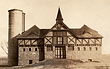

During Simpson’s years, the campus changed dramatically. It began as a simple wooden building gradually developed into a well-organized campus of permanent Sioux quartzite structures.
As more students arrived each year, the school needed more than just classrooms. Dormitories were added, vocational spaces were introduced, and farm buildings supported daily work and training. Over time, improvements such as steam heat, electric lighting, and a central boiler plant made the campus more comfortable and efficient.
This rapid expansion was supported in part through strong relationships with territorial leaders and local contributors. Simpson worked with influential figures such as Richard F. Pettigrew, whose legislative support helped secure funding for important facilities, including dormitory construction in the mid-1880s. Architectural contributions from prominent local designer Wallace Dow also played a role in shaping several of the campus buildings during this period.
By the end of Simpson’s leadership, the school had become more than a single building—it had grown into a complete educational community.
Today, each of these buildings tells part of that story. Select a building on the left to explore its history and role during the Simpson era.
Education and Daily Life
Simpson emphasized practical education alongside academics. Students were taught trades such as printing, carpentry, and tin work. The school also operated a working farm, where students gained hands-on experience.
Printing became especially important, leading to the creation of a student publication that later became known as The South Dakota Advocate.
Simpson and his family lived in the Main Building, making the school both a workplace and a home. It is believed that several of his children were born there, and family life was closely connected to daily life of the campus.

James Simpson
Born: January 21, 1855 – Michigan
Died: 1903 – Sioux Falls, South Dakota
Position: 3rd Superintendent, South Dakota School for the Deaf
Years Active: 1881 – 1903
Education: Michigan School for the Deaf
Fanwood School for the Deaf (Valedictorian)
Known For:
• Expanding SDSD from a small school to a full campus
• Construction of major buildings including the Main Building (1884)
• Development of vocational training programs
• Strong advocacy for deaf education
Notable Achievements:
• Enrollment grew from a few students to over 50
• First concrete silo in the Dakotas (1892)
• Established school printing program
Family: Wife: Anna Laura Wright
Children: Howard, Grant, Lawrence, Sara
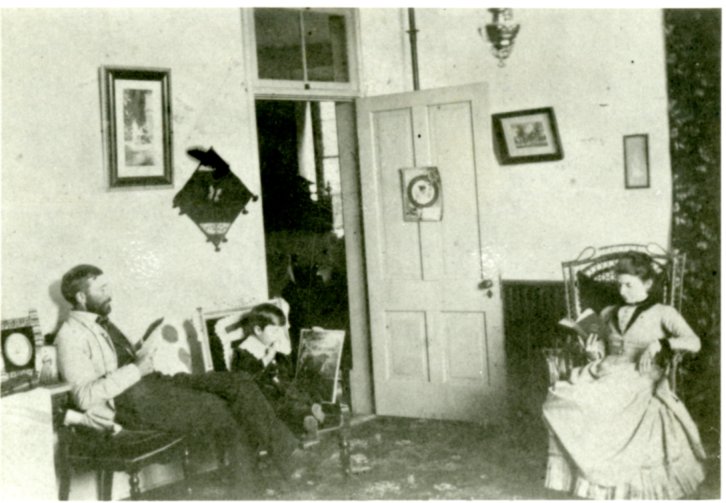
Supt. James Simpson, his son, Howard, and his wife Anna Laura, spent their reading time in the Main Building.
Photo credit: Siouxland Museum
Vocational Shop
Read page
More photos
Life on Campus
Life at the school during Simpson’s years extended well beyond the classroom. He was known for his deep personal involvement in the lives of his students.



In 1898, when a student, Lorraine Louthan, passed away at the school, funeral services were held on campus. Superintendent Simpson personally accompanied the family and the remains on their journey home, reflecting the close and caring nature of the school community.
Simpson also took part in important milestones in students’ lives. In 1899, the wedding of early student Hester Black was held on campus, showing how the school served not only as a place of education, but also as a center of community life.
He was also known to challenge false claims that targeted the deaf community. In one newspaper account from 1899, a self-proclaimed “healer” claimed he could restore hearing and speech. Simpson allowed him to attempt his method on a student—but the effort failed, exposing the claim as unfounded.

Click image to view the one of the earliest Dakota Advocate newspaper (1891)

Laura Anna Wright Simpson
Click image to view her profile
Statehood and Challenges
After South Dakota became a state in 1889, the school entered a new era under the State Board of Charities and Corrections. While state funding allowed the campus to continue growing, it also brought increased oversight and more state control.
By the early 1900s, tensions began to arise. The board introduced changes to reduce costs and reorganize the school, including adjustments to staffing, farm operations, and administrative responsibilities. As part of these changes, Superintendent James Simpson’s salary was reduced from $3,000 to $2,500, and his duties were expanded. These decisions drew increasing attention from newspapers and were not accepted by everyone.
In 1903, the situation became more public and was heatedly debated. Newspapers across the state reported on the changes and discussed the future of the school. Some accounts suggested that politics may have played a role, noting that Simpson was not aligned with the dominant Republican leadership of the time.
Reports also conflicted on how Simpson’s departure occurred. Some claimed he had been forced out, while others stated that he chose to resign rather than accept the new conditions. Simpson himself responded that he had voluntarily resigned.
As discussion spread, the issue became a matter of heated public debate over how the school should be managed and controlled. Newspapers and observers questioned the direction of the institution, reflecting broader concerns about the growing role of state authority in place of long-standing local leadership.
After more than two decades at the school, Simpson chose to step away. For many, his departure marked the end of an era and raised questions about the future direction of the institution.
Photo credit: Siouxland Museum
Final Years and Legacy
In the months following his resignation, James Simpson’s health continued to decline. In hopes of recovery, he traveled to the Black Hills, where the mountain climate was often believed to provide relief from illness. However, his condition did not improve, and he eventually returned to Sioux Falls.
By early November 1903, newspaper reports described him as critically ill at the home of his brother-in-law, Jacob Gilbert, husband of Ida Wright, sister of James' wiife Anna Laura, likely at the location of the later Wells Fargo site at 9th Street and Phillips Avenue in downtown Sioux Falls. He was suffering from a serious liver condition and was unconscious much of the time. Family members and close friends remained near him, though hope for recovery had begun to fade.
As his condition worsened, his passing became expected. Those closest to him stayed at his bedside during his final days.
James Simpson passed away on the night of November 16, 1903. His death brought to a close more than two decades of service to the South Dakota School for the Deaf—a life closely connected to the school and the community it served
“No history of the South Dakota School for Deaf Mutes can be complete without a sketch of the life of one man… James Simpson.” — Phil L. Axling, History of South Dakota (1904), quoted in The Transcendent Territory
References:
The Transcendent Territory, page 7-11 View
James Simpson Biography by Phil Axling View
James Still's research files.
Debra Bilbrey's research files.
Scott Miller's research files.
Argus Leaders
Multiply newspapers
Wikipedia.
Find A Grave.
More sources to be added soon